What is a Project Plan
A project plan is a document that contains the scope, goals, resources, timeline, and key deliverables of a project. It serves as a guide for project teams throughout project execution, ensuring stakeholder alignment on project objectives and the methods by which those objectives will be achieved.
Although the project plan is a key document, it’s not sufficient to manage a project in real time. Projects need dynamic scheduling, active coordination, resource allocation, progress tracking, and communication that goes beyond what the project plan document can provide. This is where software comes into play. Project management software helps you track milestones, organize workflows, and collaborate with the team, adapting to changes, ensuring your project stays on budget, on time, and on target.
Construction Project Plan Example
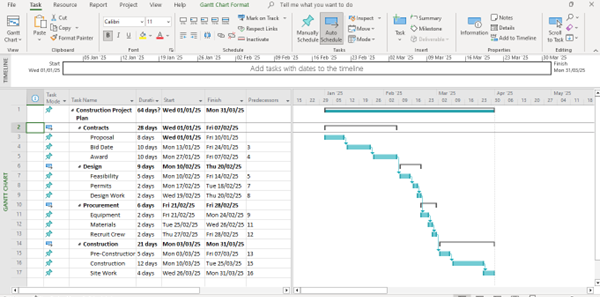
In this example of a construction project plan, the project plan is scheduled and created on a Gantt Chart. The project is broken down into small stages. There are separate stages for design, contracts, construction, and procurement.
The project starts with document management and moves ahead into procurement and permitting. Colors help identify sections and make it convenient to differentiate. This makes it easy to know when the construction work begins.
The project Gantt chart shows the start dates for tasks, the costs for resources, and the task durations. The actual cost and time are compared to the baseline to track the project schedule. The tasks on the ride side are shown on a bar chart, which is a visual representation of the project.
Event Project Plan Example
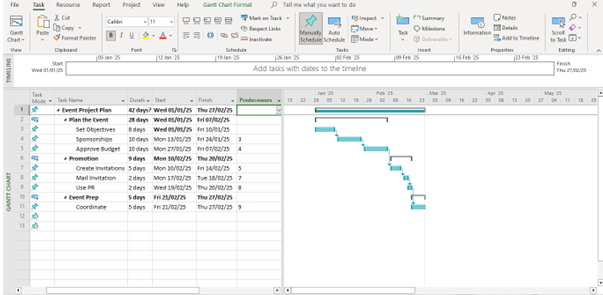
In this project plan example, the event project is divided into several phases. These phases consist of planning, event preparation, and promotion. Under these project phases are the project tasks necessary for completion. The project plan has columns on a Gantt chart to show planned efforts.
The event project starts with preparation, which is seen in the planning phase of the project. It includes everything from venue selection, creating a list of guests, and contracts with speakers. These tasks are followed by the marketing phase, which grows event awareness using advertising through physical and online media. When the event date nears, the site is prepared, and throughout the event, food services and security are coordinated to ensure the smooth running of everything.
The event project features tasks and phases. The plan has a task list on the left and a task bar chart on the right side. Some project tasks have dependencies that can be shown as linked on the Gantt chart.
Manufacturing Project Plan Example
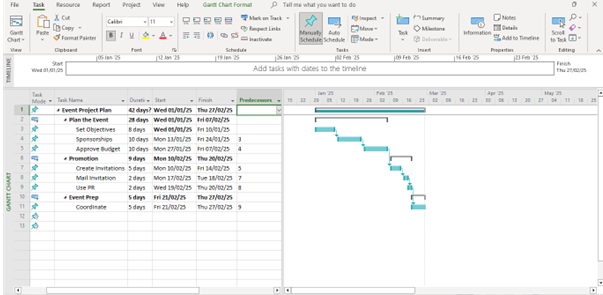
A manufacturing project starts with defining goals based on which customers’ needs and then creating a prototype that is tested to make sure it meets demand. The next step is to build a mass production for the product, which includes points where testing is done to ensure quality. While production is in process, the marketing department works on creating knowledge and interest in the product. The sales department gets orders. All of these activities are coordinated so that delivery and production meet customer demand.
The project plan for manufacturing is divided into phases. The main difference is that the project phases for manufacturing are related to this specific industry of manufacturing. They consist of a design phase, pre-production phase, and so on. The project tasks for the manufacturing project are shown on the right side in a bar chart.
IT Project Plan Example
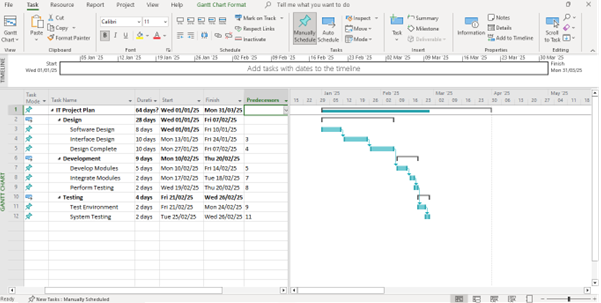
An IT project plan consists of phases for product design, product development, product testing, and so on. In the case of the IT project, one can see that the plan is illustrated in the same way as other plans.
The project plan starts with defining project goals and developing a project charter. Then, defining the technical details of the product, including layouts and system interfaces. Next comes the development and refinement of blueprints. Testing is conducted to ensure the product meets requirements, verifies functionalities, and detects defects. The Gantt chart is the right tool for projects that have interdependency between their phases and do not move to the next phase before finishing the prior phase. That’s the reason Gantt charts are the best tool for project managers.
Excel Project Plan Example
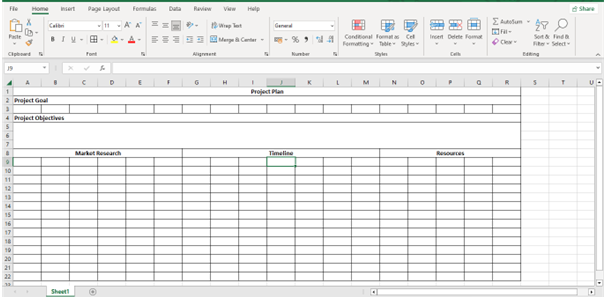
While a Gantt chart is the best tool for project management, Excel is also widely used to plan projects. Excel does not have a visual representation feature. The timeline is shown in columns and shows the start dates, finish dates, and task duration for each task. Excel breaks down the project into tasks and phases.
Lines in the Excel spreadsheet are dedicated to priority tasks, required resources, and a column for task status, which indicates the percent completion. This enables project tracking so that the tasks can be completed on schedule. Unlike other project management tools, an Excel spreadsheet is manually updated.
Agile Project Plan Example
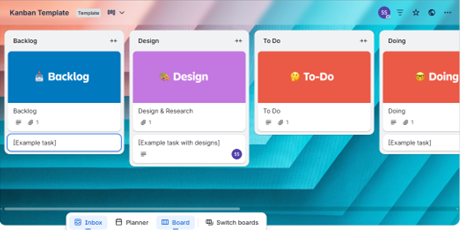
Gantt charts are not ideal for use in an agile environment. However, agile methodology uses kanban boards to work iteratively. The main advantage of using a kanban board is that the team can use the backlog to collaborate and work on user stories while planning the sprint. Meanwhile, the scrum master and the product owner can spot bottlenecks.
The scrum team breaks down the kanban board into project phases. For example, there are columns for items in the backlog, work in progress, and completed work. Each column has task cards under it that move as work is done throughout the cycle of production.
Word Project Plan Example
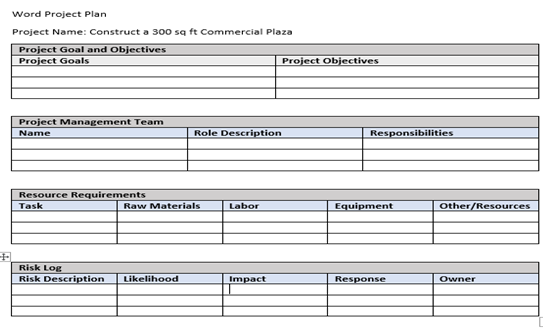
Project planning includes coordination of many things, from recruiting human resources to forecasting project budget and defining objectives and goals. The benefits of a word project plan are that it helps gather all the data in a single place. Every field on the project plan makes it easy for project stakeholders to see details about the project. It also helps keep the project team on the same page while understanding the requirements to deliver a successful project. The only issue with a word project plan is that the details on it have to be moved to the software manually.
Project Plan Example Document
The project plan sample below shows how you can execute and complete a project. It offers a structure to organize tasks, resources, timelines, and responsibilities.
Project Overview
The project objective is the construction of a 1500 square foot home within a time period of 4 months, and a budget of $300,000. The home will have 2 bedrooms, 2 bathrooms, a living room, a kitchen, and a garage. The project will be executed using the waterfall project management methodology.
Scope Management
The project scope includes:
Preparing the site, laying the foundation, developing the frames, roofing, HVAC, and electrical works, finishing work, and final inspection.
Exclusions:
Furnishing and landscaping are not included. The project scope will be managed using a project scope statement and work breakdown structure. Changes to the scope will require approval.
Schedule Management
A Gantt chart will be used to define dependencies and activities. Major project milestones are:
· Approval of Permits: Week 1
· Completion of Foundation: Week 4
· Completion of Framing: Week 8
· Inspection: Week 20
· The project progress will be tracked weekly using MS Project.
Cost Management
Estimated project cost: $300,000
Contingency reserves: $10,000
Quality Management
Quality standards for the construction project include structural safety, local building codes, and energy efficiency certifications. Inspections will be conducted at the foundation and framing stages. Nonconformance will be corrected before moving on to the next phase.
Resource Management
Resources include subcontractors and general contractors, a project manager, an architect, and a construction team. Resources will be hired on a contract basis. Availability of resources will be reviewed on a weekly basis.
Communications Management
Weekly meetings will be conducted with the contractors. Communications will be handled through shared folders and via email. The RACI matrix will be used for stakeholder updates.
Risk Management
Key project risks include material shortages, permit delays, and weather delays. The risk register will be updated twice a week.
Procurement Management
Project procurement includes procuring materials and services. Procurement contracts will mostly be fixed-price, and procurement will follow policy and include evaluation.
Stakeholder Management
Stakeholders include the homeowner as the project sponsor, the contractor, the architect, and the building inspector. Stakeholder engagement strategies include engaging the sponsor in designing and finishing selections and keeping the inspector informed about timelines.
Change Management
The project manager receives change requests in writing. The project manager then evaluates the impact of the change on schedule, scope, and cost. Approved changes are reflected in the baseline.
Project Plan Examples- FAQs
What are the 7 steps of a project plan?
The 7 key steps for project planning are: defining the project goals and scope, stakeholder identification, task breakdown and creating a schedule, allocating budget and resources, creating a strategy for risk management, developing a communication plan, and finalizing the plan and getting stakeholder approval. These steps act as a framework to make sure the project is achievable, clear, and well-managed from initiation to completion.
What are the four questions needed to make the project plan?
The four key questions in making a project plan are ‘What’, ‘Why’, ‘When’, and ‘Who’. These questions clarify the project goals, purpose, timeline, and team members.
What is the main purpose of project plans?
The objective of a project plan is to create a roadmap that provides a guideline for a project. A project plan defines the project objectives, scope, resource needs, and timelines.
What is a good example of a project?
Some good project examples are building an apartment building, a hotel, a house, or a hotel.
Do Follow our Tools and Techniques Section for more relevant articles
Do Follow our YouTube Channel for more relevant articles